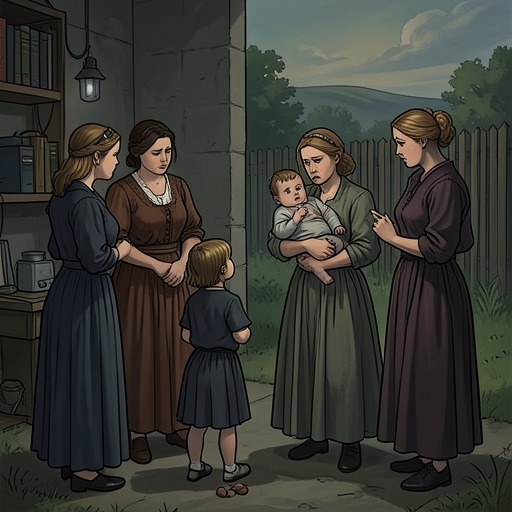
Salome’s Drugging and Taking of Her Son Aaron
Women TalkingSalome’s bond with her son Aaron turns the women’s planned departure from Molotschna Colony into an immediate personal crisis. When Aaron is reported missing shortly before the group sets out, Salome first insists that he must be occupied with the horses; once she learns he is not where expected, she refuses to leave without him. She eventually finds him already in a buggy and discloses that she used the spray on him so he would come with her. Her decision makes maternal responsibility both the reason to leave and the limit she will not cross in leaving anyone behind.
Motherhood within a collective departure
The women’s plans place family attachment under pressure. Salome has a son to leave behind while the group prepares to depart, and Agata recognizes the grief this creates. She comforts Salome by framing the temporary separation from Aaron as a reason for her, and the other grieving mothers, to build a better colony. That reassurance assumes a future reunion and asks Salome to endure separation for the larger undertaking. The later discovery that Aaron is missing exposes how fragile that expectation is: the planned distance between mother and son threatens to become an immediate and possibly lasting one.
The crisis is not isolated from the group’s deliberations about children. Salome questions why boys aged thirteen and fourteen are excluded from the arrangements that allow younger boys to accompany the women and older boys to be in the city with the men. She fears that if the accused men return to the colony, the adolescent boys could become targets in the absence of girls and women. Mejal supports the question, and August Epp answers that boys of this age can cause harm but remain children who can be taught. The exchange establishes that Salome’s concern extends beyond her own son: her view of protection is shaped by a wider duty to children, even as Aaron’s immediate safety becomes the urgent test of that duty.
The report that Aaron is missing
As the women discuss how the strongest among them will walk beside the buggies and the children, Nettie/Melvin tells Salome that Aaron is missing. He had not come to the summer kitchen for lunch with the other children. Salome resists the conclusion at first. She explains that she had asked Aaron to prepare the teams, water the horses, pick burrs from their saddle blankets, and clean their hooves. Because she expects him to be working in a barn, she says the missed lunch does not prove he is missing.
The practical detail matters: Salome’s first response is to account for Aaron through the work she assigned him. She is not ready to treat his absence as a reason to abandon the departure, nor does she immediately accept that he has disappeared. But the group is close to leaving, and when the prospect of going without him is stated plainly, she draws a firm boundary. She says she will not leave without her son. Mariche points out that Salome had just seemed ready to go and argues that everyone is leaving people behind; Salome, in her view, should not receive special allowance for her distress. Their disagreement brings the collective cost of departure into direct conflict with a mother’s particular responsibility to her child.
Finding him in the buggy
The uncertainty ends when August Epp asks where Aaron is. Salome tells him she has found her son and that he is already in the buggy, waiting. Asked whether she persuaded Aaron to leave, she says she did not: she used the spray on him as well. Her action has secured his presence with the departing group, but it has not come through a conversation or a recorded choice by Aaron. The distinction makes the reunion an act of urgent maternal decision rather than a mutual agreement.
Salome explains that Aaron cannot stay in the colony. She compares taking him with her to carrying a sleeping child away from a burning house. The comparison expresses the emergency as she understands it: waiting for his decision risks leaving him where she believes he must not remain. She also makes clear that the women will already be gone if he changes his mind. The finality is deliberate. She intends to take responsibility for the consequence herself rather than gamble on a later opportunity to bring him along.
Protection, agency, and the unresolved cost
Salome’s action does not resolve every tension in the relationship. Aaron is with her, but the account does not describe his response once he wakes or establish that he has chosen the departure. The narration instead closes on Salome’s insistence that he is her child and is coming with her. Her maternal claim functions as both a bond and an assertion of authority: in the face of danger and a rapidly closing departure, she decides that protecting him outweighs waiting for consent that may come too late.
The episode also connects Aaron’s removal to Salome’s action toward Scarface Janz. She tells August Epp that she sprayed him too and says that he had been planning to go to the city to tell the men. The narrative places these disclosures together without detailing the full circumstances. In Aaron’s case, Salome’s stated reason is that he cannot stay; in the other case, the planned report supplies the immediate context for her intervention. Both acts occur as the women prepare to leave, showing how the departure forces Salome to act quickly around people whose presence or decisions could affect the group’s safety.
The relationship is therefore presented through a sequence of practical and consequential acts: Salome assigns Aaron work with the horses, searches for an explanation when he fails to appear, refuses to leave without him, and secures his place in the buggy. The movement from expectation to alarm to decisive action gives the mother-son bond a central role in the departure. Salome does not treat separation as an abstract sacrifice shared evenly by the group; when Aaron’s absence makes that sacrifice immediate, she changes the plan in order to keep her child beside her.